SLED Approved · 40 Instructional Hours · 5 Days
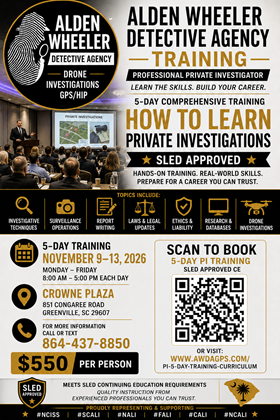
PI 5-Day Academy
Comprehensive Training Curriculum
Pre-Licensing & Professional Training · Alden Wheeler Detective Agency · Anderson, SC
Program Information
Program Title
Comprehensive PI Pre-Licensing & Professional Training
Duration
5 Days · 40 Total Instructional Hours
Format
In-Classroom, Scenario-Based & Field Exercise
Regulatory Body
SC Law Enforcement Division (SLED)
Certifying Agency
Alden Wheeler Detective Agency
Target Audience
Pre-licensing candidates and working PIs seeking full professional training
Credit Hours
40 Hours · 5 Days
Max Enrollment
20 Students Per Session
Location
Crowne Plaza — 851 Congaree Road, Greenville, SC 29607
Date and Time
November 9–13, 2026 (Monday–Friday) · 8:00 AM–5:00 PM each day
Price
$550 per person
Program At a Glance
| Day | Focus Area | Hrs |
|---|---|---|
| Day 1 | Foundations & SLED Licensing | 8 |
| Day 2 | Surveillance & Technology | 8 |
| Day 3 | Legal Framework & Evidence | 8 |
| Day 4 | Advanced Operations | 8 |
| Day 5 | Professional Practice & Final Assessment | 8 |
Program Overview
5-Day PI Training Academy
The Alden Wheeler Detective Agency Five-Day PI Training Academy is a comprehensive, instructor-led program covering every essential skill and legal requirement for professional private investigation practice in South Carolina. Designed for both pre-licensing candidates and experienced investigators. Each day consists of 8 hours of instruction combining classroom lecture, case studies, hands-on exercises, scenario simulations, and written assessments. Certificate of completion issued upon passing the final examination.
Training Schedule
DAY 1
DAY 2
DAY 3
DAY 4
DAY 5
Day 1 — Foundations & SLED Licensing
8 Hours of Instruction · Modules, Exercises & Assessment
Learning Objectives:
Understand the legal framework governing PIs in SC
Master SLED licensing requirements and ineligibility criteria
Establish professional business foundations including contracts
Understand the defined scope of PI authority
Apply ethical standards to professional PI practice
| Time | Session | Min |
|---|---|---|
| 0800–0830 | Welcome, Introductions & Program Overview | 30 |
| 0830–1000 | 1-A: Introduction to PI in SC | 90 |
| 1000–1015 | Morning Break | 15 |
| 1015–1145 | 1-B: SLED Licensing Requirements | 90 |
| 1145–1230 | 1-C: SLED Ineligibility — Disqualifying Factors | 45 |
| 1230–1315 | Lunch Break | 45 |
| 1315–1445 | 1-D: Contracts, Agreements & Business Operations | 90 |
| 1500–1600 | 1-E: PI Authority — Can & Cannot Do | 60 |
| 1600–1645 | 1-F: Professional Ethics & Standards | 45 |
| 1645–1700 | Day 1 Review, Q&A & Written Quiz | 15 |
1-A: Introduction to Private Investigation in SC: 90 min
History and evolution of the PI profession in SC · Role of SLED in licensing and regulation · SC Code of Laws Title 40, Chapter 18 — PI Act · Types of PI work: domestic, insurance, corporate, legal support, missing persons · Career paths — agency owner, employee, contract investigator · Professional associations: SCALI, NALI, World Association of Detectives
1-B: SLED Licensing Requirements & Application Process: 90 min
Minimum qualifications: age, citizenship, background · Application documents checklist · Individual PI license vs. Agency license · Employee investigator registration · Fingerprint cards for SLED and FBI · License fees, payment, processing timeline · Annual renewal requirements — CE hours, fees
1-C: SLED Ineligibility — Disqualifying Factors: 45 min
Felony conviction — automatic disqualification · Crimes of moral turpitude · Prior license revocation · Drug/alcohol history · Mental health adjudication · Dishonorable military discharge · False application statements — criminal and civil consequences · Class Exercise: Review case scenarios — eligible or ineligible?
1-D: Contracts, Client Agreements & Business Operations: 90 min
Essential contract elements · PI services agreement template walkthrough · Retainer agreements — structure, billing, replenishment · Attorney-client privilege when retained by counsel · Non-disclosure and confidentiality provisions · Termination and dispute resolution · Record retention minimum 5 years · Business entity considerations — LLC, sole proprietor, corporation · Insurance: E&O, general liability, auto · Hands-On: Draft a client services agreement
1-E: PI Authority — What You Can and Cannot Do: 60 min
- Authorized: Surveillance · Witness interviews · Public records · Skip tracing · Serve civil process · Background investigations · Undercover operations (no LE impersonation) · Court testimony.
- Prohibited: Impersonating LE (FELONY) · Wiretapping · Trespass · Pretexting · Arrests · Weapon violations · Harassment · Entrapment · Operating without SLED license.
- Case Study: Real-world PI license revocations in SC
1-F: Professional Ethics & Standards of Conduct: 45 min
PI Code of Ethics · Client confidentiality vs. mandatory reporting · Conflicts of interest · Social media professional conduct · Avoiding entrapment, harassment, stalking allegations · SLED complaint and disciplinary process
Day 2 — Surveillance Operations, GPS & Technology
8 Hours · Plan/execute fixed and mobile surveillance · GPS tracking · Photo/video evidence · Chain of custody
| Time | Session | Min |
|---|---|---|
| 0830–1000 | 2-A: Surveillance Planning & Operations | 90 |
| 1015–1115 | 2-B: Fixed Surveillance Techniques | 60 |
| 1115–1230 | 2-C: Mobile Surveillance — One-Car & Multi-Car | 75 |
| 1315–1415 | 2-D: GPS Tracking — Law, Deployment & Data | 60 |
| 1430–1545 | 2-E: Photography & Video Evidence | 75 |
| 1545–1645 | EXERCISE: Surveillance Scenario Simulation | 60 |
| 1645–1700 | Day 2 Debrief & Written Quiz | 90 |
2-A: Surveillance Planning: 90 min
Pre-operational intelligence gathering · Mapping the operational area · Equipment preparation checklist · Legal review before deployment · Coordinating with client · Creating a surveillance log template
2-B: Fixed Surveillance Techniques: 60 min
Vehicle selection and positioning · Angles of observation and blind spots · Maintaining cover over extended periods · Neighborhood surveillance · Using natural cover and commercial locations · Time-entry log, photo/video log documentation
2-C: Mobile Surveillance: 75 min
Single-vehicle mobile follow · Two-car and three-car teams · Urban vs. rural following techniques · Losing the subject — recovery protocol · When subject is burned — aborting to protect case integrity · Hands-free dictation techniques while mobile
2-D: GPS Tracking: 60 min
US v. Jones (2012) impact on PI GPS use · SC law on electronic tracking · Ownership consent requirement · Employer/employee fleet tracking · Domestic case spousal GPS landscape · Device selection: battery, accuracy, geofencing · Placement: undercarriage, wheel wells, OBD ports · Admissibility of GPS evidence in SC courts
2-E: Photography & Video Evidence: 75 min
Equipment standards — resolution, zoom, low-light · Camera settings for surveillance · Video: establishing shot, medium, close-up sequence · Timestamp verification before every deployment · SC one-party consent law for audio · Never alter, crop, or filter evidentiary media · File naming convention · Chain of custody from capture to submission
Day 3 — Legal Framework, Evidence & Documentation
8 Hours · Constitutional privacy law · Camera placement · SC statutes · Evidence management · CWP
3-A: Constitutional Law & Privacy Foundations: 90 min
Fourth Amendment — unreasonable searches and seizures · Katz v. United States — reasonable expectation of privacy standard · Public vs. private spaces · Third-party doctrine · SC Constitution privacy provisions (broader than federal) · Curtilage doctrine · Open fields doctrine
3-B: Camera Placement — Where You Can & Cannot Record: 90 min
- LAWFUL: Public streets, sidewalks, parking lots, commercial areas · Exterior workplace and vehicles in public · Client's own property with written authorization.
- UNLAWFUL: Inside any private residence · Bathrooms, changing areas, bedrooms (FELONY) · Areas requiring trespass · SC Code § 16-17-470 — Video Voyeurism statute and penalties.
- Exercise: 10 scenarios — identify lawful vs. unlawful placement
3-C: SC Criminal Statutes Affecting PIs: 45 min
Impersonating LE — SC Code § 16-17-730 — FELONY · Stalking and harassment statutes · SC Wiretapping Act — one-party consent and limits · Trespass — criminal and civil liability · Computer crimes act — unauthorized access · Identity theft and pretexting prohibitions
3-D: Evidence Management & Chain of Custody: 90 min
What is chain of custody and why it matters · Evidence log from point of capture · Secure storage — encrypted drives, locked physical storage · Evidence transfer documentation · When evidence is subpoenaed — obligations · Digital metadata: timestamps, GPS data, device ID · Hands-On: Create a complete evidence log for a sample case
3-E: Concealed Weapons Permit & the Private Investigator: 75 min
SC CWP Act — separate credential from PI license · CWP requirements: 8-hour firearms course, SLED background check, 21+ years old · Prohibited locations: schools, government buildings, courthouses · Duty to identify weapon to law enforcement · Use of force: Castle Doctrine, stand your ground · PI has NO special authority beyond ordinary citizen · Maintain weapons qualification
Day 4 — Advanced Operations
8 Hours · Drone ops · Process serving · Report writing · Court testimony · Affidavits
4-A: Drone Operations: 90 min
FAA Part 107 — certification overview · Registration requirements for drones over 0.55 lbs · Operational limitations: altitude, VLOS, prohibited airspace · Airspace authorization — LAANC system · Pre-flight checklist: weather, battery, airspace, emergency plan · SC drone statutes § 55-1-30 · Privacy considerations from the air · Evidence metadata, admissibility, authentication · Practical: Airspace check and pre-flight planning exercise
4-B: Process Serving: 90 min
Authority of PI to serve process in SC — Rule 4, SCRCP · Who may be served — individuals, corporations, government entities · Personal service, substituted service, corporate agent service · Service of protective orders · Subpoenas — witness, deposition, document production · Affidavit of service — required elements · Proof of service filing with court
4-C: Process Serving Scenarios: 45 min
Scenario 1: Evasive residential subject · Scenario 2: Business service — identifying correct agent · Scenario 3: Refused service — proper technique and documentation · Scenario 4: Subject not found — skip trace and publication service referral · Students draft return of service documents for each scenario
4-D: Report Writing for Court: 90 min
Report header requirements and case number · Writing a factual activity log — first person, past tense, chronological · Describing physical observations — specificity and objectivity · Referencing exhibits: photo, video, GPS log · Findings summary · Avoiding opinion, speculation, and advocacy · Hands-On: Write a complete investigation report from sample surveillance notes
4-E: Drafting Affidavits: 60 min
Legal definition and purpose of a sworn affidavit · Standard opening: "I, being duly sworn..." · Numbered paragraphs for each material fact · Personal knowledge standard only · Identifying and attaching exhibits · Notarization requirements in SC · Hands-On: Draft an affidavit from a sample investigation
4-F: Testifying in Court: 45 min
Qualifying as expert vs. fact witness · Direct examination — presenting your findings · Cross-examination — staying calm, correcting misrepresentations · Referring to your report properly · Hypothetical questions — how to respond · Impeachment attempts — how to handle · Role Play: Sample direct and cross-examination of PI report
Day 5 — Professional Practice, Ethics & Final Assessment
8 Hours · Mileage/billing · Reciprocity · OSINT · Skip tracing · Comprehensive scenario · Final examination
5-A: Mileage, Billing & Professional Documentation: 60 min
Odometer log — starting, ending, total per operation · IRS mileage rate vs. contract rate · GPS-corroborated mileage documentation · Itemized invoicing — time entries in tenths of an hour · Expense categories: equipment, lodging, meals, court costs · Billing for standby and travel time · Retainer draw-down statement format · Tax documentation — Schedule C · Hands-On: Prepare a complete client invoice from sample activity log
5-B: Reciprocity — Multi-State PI Operations: 45 min
SC PI license — no automatic national reciprocity · How to determine recognition in another state · NC, Georgia, Florida — current requirements · Legal exposure when following subject across state lines · Sub-contracting to locally licensed PI · Interstate service of process — federal vs. state court distinctions · Contact receiving state licensing board before multi-state ops
5-C: Digital Investigations & OSINT: 60 min
Open-source intelligence — publicly available information · Social media investigation: Facebook, Instagram, LinkedIn, TikTok · Legal use of social media evidence · Court records — SC eCourts, PACER for federal · Property records, business entity records, voter registration · Commercial databases — LexisNexis, IRB, TLO — legal limitations · DPPA — Driver's Privacy Protection Act compliance
5-D: Skip Tracing & Locating Subjects: 60 min
Public records layering strategy · Utility records, vehicle registration, professional licenses · Associates and family members as investigative leads · Social media geolocation techniques · Commercial skip trace tools and legal limitations · Documentation of methodology for court
Comprehensive Scenario Exercise — Integrated Case Simulation: 75 min
Each student receives a complete case packet — domestic investigation scenario · Must identify subject, develop surveillance plan, identify legal constraints · Must draft: surveillance activity log, one-page report, and affidavit · Must complete: client invoice with mileage and expenses · Instructor evaluates all documents using court-standard rubric
Final Examination & Grading Rubric
Final Exam — 100 Questions
The final examination consists of 100 multiple-choice and short-answer questions covering all five days of instruction. Students must achieve a minimum score of 75% (75/100) to receive a certificate of completion. Students who do not pass will be offered a remediation session and one retake opportunity.
- Section 1: Licensing & Legal (25 q) — Days 1 & 3
- Section 2: Surveillance & Technology (25 q) — Day 2
- Section 3: Documentation & Court (25 q) — Day 4
- Section 4: Professional Practice (25 q) — Day 5
Assessment Weights
| Component | Weight | Pass |
|---|---|---|
| Daily Quizzes (Days 1–4) | 20% | 75% |
| Day 4 Report & Affidavit Exercise | 20% | 75% |
| Day 5 Comprehensive Scenario | 20% | 75% |
| Final Examination (100 questions) | 40% | 75% |
Students who achieve an overall program average of 85% or higher will receive the designation of DISTINGUISHED GRADUATE on their certificate of completion.
Required Texts & References
- South Carolina Code of Laws, Title 40, Chapter 18 — Private Investigator Act
- SC Rules of Civil Procedure, Rule 4 — Service of Process
- SC Code § 16-17-470 — Video Voyeurism
- SC Code § 23-31-210 — SC Concealed Weapons Permit Act
- SC Code § 55-1-30 — Unmanned Aircraft Systems
- FAA Part 107 — Small Unmanned Aircraft Systems
- 18 U.S.C. § 2511 — Wiretap Act
- 18 U.S.C. § 2721 — Driver's Privacy Protection Act
- United States v. Jones, 565 U.S. 400 (2012) — GPS and Fourth Amendment
- Katz v. United States, 389 U.S. 347 (1967) — Expectation of Privacy
Equipment Checklist for PI Operations
- Camera — minimum 20MP with telephoto capability
- Video camera — minimum 1080p, optical zoom
- Binoculars — minimum 8x magnification
- GPS tracking device — with data export capability
- Dash camera — for vehicle mileage and approach documentation
- Surveillance log forms — pre-printed or digital tablet
- Covert recording device (audio) — SC one-party consent compliant
- Drone — FAA registered, operator Part 107 certified
- Laptop — for database access, GPS data download, report drafting
- First aid kit and emergency contact list